
“The root trauma, and what causes deep human suffering, is our disconnection from Nature,” says Julie Brams LMFT, an Earth-centered psychotherapist, and Certified Forest Therapy Guide.
“We were all once deeply connected to Nature,” she says. “But we have been steeped for so long in an anthropocentric ideology people have forgotten that fact. We are now almost completely mentally and artificially severed from Nature, and it is extremely painful for human beings to be caught in this delusion.”
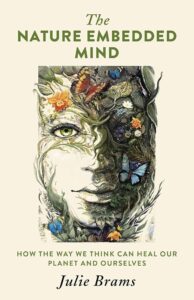
Her recently published book – The Nature Embedded Mind – teaches people how to re-root their minds and come back into right relationship with Nature through a standardized, repeatable practice.
“Reconnecting is a practice,” she says. “De-centering humans and remembering how to relate with other-than-humans the way our ancestors did takes time and consistency. In this repair work. the Earth, the land, is the therapist. My role is setting a container and acting as a guide for these natural relationships to grow.”
She starts by asking people to notice the current condition of their relationship with Nature.
“If you want a family to get healthy, you facilitate their communication, their bond, their heart connection. It’s the same with Nature. You have to learn to listen to it, with all of your senses and learn to communicate, which may or may not mean talking. Engaging with all your senses as well as your heart,” Brams says. “helps people remember what they experienced as children and ultimately leads to realizing that they are Nature. This realization is life changing in some very positive ways.”
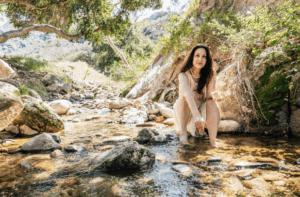
One of the group practices she leads is rooted in the Japanese science of shinrin-yoku (forest bathing), which is a practice of using the senses to experience Nature. “Forest, she says, is really shorthand for anywhere out of doors. Bathing is surrounding yourself in the atmosphere – the earth, the air, plants, insects, animals, the microbial world – “the more-than-human world.”
Brams encourages us to breathe it in, hear it, touch it, look at it, smell it, and taste it. “Notice how Nature grabs your attention.”
Brams came to this work through her lifelong fascination with human potential, consciousness, and the natural world. She believes that to be optimally human, we must repair the root trauma of our disconnection from Nature.
“In the modern world, it’s socially acceptable to have a relationship with a dog,” Brams says. “But what about a cactus? We’re often shamed as crazy if we listen to a boulder or labeled a tree hugger if we honor our kinship with a tree. Yet these are essential heart-to-heart relationships with our other-than-human family. Relationships that allow us to be more relaxed and alive.”
“We have to unlearn the shame, the concepts that keep us isolated, and heal the trauma that causes so much anxiety, depression and loneliness in us. Until this original wound is addressed, we will continue to cause harm to each other and the planet,” says Brams.
Her psychotherapy practice integrates traditional therapy, ecopsychology practices, meditation, and the latest advances in the field of neuropsychology. Her wellness company, elemental (ExperienceElemental.com), is devoted to helping people unlearn the preconceptions and thinking that dominates modern society, and relearn how to reciprocally reconnect with the rest of Nature. She and her co-founder, Julia De’Caneva, lead Nature immersion experiences and workshops, classes and re-rooting practices that take these ideas into everyday life. The benefit of these practices is an immediate sense of relaxation and reduction of stress, anxiety and depression.
In addition to helping individuals and groups, Brams’ mission is to create change in the field of Western psychology. She would like to see our disconnection from Nature acknowledged as a mental health issue and the healing of this disconnection become the new foundation for all mental health.
Learn more at www.experienceelemental.com or by picking up a copy of The Nature Embedded Mind.
#
Article Written By Wendy Wong