
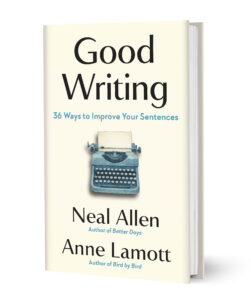
Good Writing
36 Ways to Improve Your Sentences
Written By: Neal Allen and Anne Lamott
Filled with enlightening practical tips that change the way we look at language, writing, sentence structure, and the finished pieces we send out into the world, Good Writing and its rules share a lively dynamic all their own. Known worldwide individually, the electric talents of Neal Allen and Anne Lamott leap off the page, engaging readers in learning and laughing through the writing journey. I read it cover to cover in one sitting and loved it. What a privilege to have a glimpse into the minds of these writing giants.
Good Writing is made up of 36 rules for writing that Allen collected over years as a lifelong journalist, non-fiction writer, and his own self-declared title as a “hack writer.” After his detailed description of the what and the why of each particular rule, Lamott takes the reins, offering her own interpretation with her signature style of warmth and wit. This blueprint for writing better sentences is delivered with the same care and concern in which it was crafted. The point of it all: keep writing.
Tapping into the psyche of both seasoned and novice writers, these 36 rules offer something familiar, welcoming to all. The nudging suggestions make you sit up and take notice, sharpen focus, and become better in the doing of writing. Allen shares that he noticed patterns over time, sought out lists of rules or guidelines, and when he couldn’t find a full-throated list, he wrote one himself. These legendary writers weave a dance between Allen, a conscientious journalist who honed his craft while hitting deadlines, and Lamott, the literary alchemist who knows all the rules and freely bends them while telling stories that reach far beyond the pages. Her epic works have touched our souls, made us laugh, inspired us, and taught us practical wisdom that sustains. The married couple know the steps each takes before they take them. The pairing is extraordinarily powerful.
There’s a playfulness in their delivery, a loving tension as they intertwine their voices and views in choreographed artistry perfected over time. The rule is paramount, how to use it varies. Each author shows exactly how to bring the rule into focus and use it well. Their lenses are different, they don’t always agree, and their voices each carry a weight all their own. Readers will learn from both, hone in on the lesson, and stay for the humor, curiosity, pedigree, talent, respect, and experience shared in each interpretation.
Every sentence offers hope and guidance to budding and established writers. We’re reminded to ditch the boring stuff, trust our voice, learn rules (then wiggle them if you must), find great editors, and remember that the first draft is where we start our stories.
Good Writing is a gift to writers everywhere. For a chance to be in the room with these creative titans, grab your tickets to spend an evening with Neal Allen and Anne Lamott in conversation with festival Director Marni Freedman on April 1st at Balboa Theater in San Diego. TICKETS
Interview with Neal Allen and Anne Lamott
Your wit and humor threads throughout the entire book. What tips do you have for new writers to engage audiences with a sense of humor?
Annie: I started writing as a kid, and always tried to be funny because I was funny in real life. The problem was that I tried too hard, in a show-offy way. It was a bit sophomoric. I had to train myself to be restrained and selective. I recommend reading books by the people whose humor you enjoy. For me growing up it was Thurber, PG Wodehouse, Vonnegut, and Salinger. Then I started to look forward to everything Nora Ephron wrote, and some of the funny feminist novelists. I watched their timing and rhythm, and started emulating them until I could find my own voice.
Neal: Rewrite. Nothing requires more finesse than humor. Here’s the great New Yorker humorist James Thurber when interviewed by the Paris Review: “A story I’ve been working on – ‘The Train on Track Six,’ it’s called – was rewritten fifteen complete times. There must have been close to two hundred and forty thousand words in all the manuscripts put together, and I must have spent two thousand hours working at it. Yet the finished version can’t be more than twenty thousand words.” Elsewhere he said, “The first or second draft of everything I write reads as if it was turned out by a charwoman.”
Were there other rules/tips that didn’t make it into this book? Can you share some of those and why they didn’t make the cut?
Neal: I thought of one the other day, but I forgot to write it down and now I’ll have to wait until I’m reading something that jogs it back into view.
Annie: None that I can think of. By the time I started collaborating, Neal had done all the heavy lifting. All the rules were in place—well, except for two I did add at the time: Write the hard stuff, and air out the boring stuff.
With your different approaches to writing and leaning on each other as trusted editors in your own work, how did you find collaborating together on these particular rules that have been game changers in your writing journeys?
Neal: It was pretty easy. I wrote all my essays first. Only after showing it to Annie did she suggest the call-and-response format. So she wrote all her essays as responses to mine. It turned out to be a great format. I’m an explainer and deconstructor and Annie is more interested in analogy and catharsis. I analyze and Annie brings it home.
Annie: It was actually so easy, and fun, because as I said, Neal had done all the heavy lifting. I got to enter in and be more playful, and definitely more motherly. Then we edited each other’s passages, and I think I made his more playful, and he made mine more instructive.
For those new writers in the room, how will they know when to stop tinkering with a sentence? When is the ‘dental’ edit truly finished?
Annie: Well, at some point you start hurting the work when you go over and over it too many times. You may need a writing partner or a group who can tell you that it is just fine.
Neal: I shrug and send it in. If it’s not ready, the editor will tell me. I have a daily journalism background, so my deadline tells me when it’s finished. If you don’t have an editor, your writing group will tell you. Just don’t be disappointed if they say you are a full draft away from ready. That’s a good thing. You won’t believe how much better it looks when you’ve taken their suggestions.
When mentoring novice writers, what are three pieces of wisdom you’d each share?
Annie:
1. Set a time when you can write for a while every day, or five days a week. Then get your butt in the chair and through whatever bribes and threats work best for you, write one whole passage or scene.
2. Let yourself write a really terrible first draft, and make yourself finish it.
3. Act respectfully with yourself as you go back over it, being careful about the self- talk—“This sucks.” “Why can’t I figure out how to end it?” Be encouraging, and firm, about taking out long descriptions etc., the way you would be with a friend whose work you respect.
Neal:
1. Read literary fiction; most of good style is learned osmotically, from hearing the unusual phrasings and usages of the greats. Read well to write well.
2. Find your strengths and amplify them; you’re probably good enough already at what you think are your weaknesses.
3. Don’t ever beat yourself up over a first draft. That one’s temporary and no matter how terrible it is, your choices have been narrowed to a manageable bunch.
Written By: Stacey Ebert