
By Wendy Wong
Sue William Silverman is an essayist, poet, memoirist, writer of creative non-fiction, and a teacher of creative writing. She shares some of the most personal and vulnerable life experiences in her writing. Her first book, Because I Remember Terror, Father, I Remember You,* is a memoir about having grown up in an incestuous family. Her second book, Love Sick: One Woman’s Journey through Sexual Addiction, chronicles twenty-eight days in rehab to recover from her own sexual addiction. (Love Sick was made into a Lifetime TV movie.) Her third book, The Pat Boone Fan Club: My Life as a White Anglo-Saxon Jew, is her story of a misguided search for spirituality, as a Jewish girl yearning to be adopted by Pat Boone, a Christian, a pop singer, TV personality, and father of four – her ideal notion of a perfect father. Her fourth book, How to Survive Death and Other Inconveniences, discusses her fear of death and dying– not just physical death, but emotional or spiritual deaths that take place through divorce, illness, or other terrible things that happen in life.
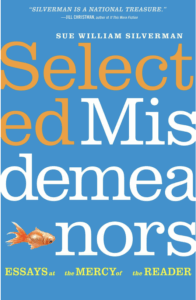 In her latest book, Selected Misdemeanors: Essays at the Mercy of the Reader (University of Nebraska Press, September 2025), Silverman writes about her own transgressions, miscalculations of love, inner and outer betrayals in matters of the heart. These “selected misdemeanors” kept her awake at night, so she would write at 3 a.m. to make sense of unresolved conflicts.
Selected Misdemeanors is a collection of flash essays, or as Silverman describes them, flashes of time that reveal quick and shimmering epiphanies. “It’s not just that it’s short, it must be revelatory,” she explains. “You have to come up with an image that lingers. You need to have a strong image that the essay revolves around, because that’s what will linger with the reader.”
“Selected Misdemeanors is about discovering a sense of self, of finding Home,” she shares. “We tend to remember the big events like getting married or divorced, but most of life is made up of small incremental moments in time.”
Silverman has written numerous other books – two craft books, memoirs, collections of poetry, collections of essays, and flash non-fiction. Silverman describes creative non-fiction as “looking for the universal in the personal – a way to discover the metaphors of your life, in that particular scene, moment or book.” Metaphor is what makes our story universal. By finding metaphors to represent feelings of loss, feelings of love. If you don’t relate to the surface story, perhaps you would relate to the metaphor.”
“Whether you’re writing memoir, flash non-fiction, or personal essay, you first focus on a rough draft before digging deeper into the metaphor that underlies the life experience. Metaphor gives meaning to what happened. The metaphor at the center of each story is what makes our life experiences universal,” says Silverman.
As an example, in Selected Misdemeanors, she shares an essay called “Scratching the Surface.” It’s a simple story, she says. “I was rollerskating, I fell, I scratched my knee as a kindergartner. But that was only a small part of the story. After twenty, twenty-five revisions, I came to understand the meaning of that long-ago moment: that this scratch in my skin was an opening to a whole other universe. There’s an inside to an outer body, and that led to an even deeper realization that there’s a soul, a whole inner person. Why did that moment stay with me? The real meaning of this essay is to understand the depth of what being human means.”
In Love Sick, she shares the image of a maroon scarf she had taken from an older, married man she had an affair with as a college freshman. Through this process of sitting with this image of the scarf, during the writing process, she came to understand that the scarf was a metaphor for the fact that she could never have the man. She could only have his scarf. And that the scarf represented both loneliness and comfort.
For writers who feel stuck, or unable to excavate their own vulnerabilities so effectively, Silverman encourages finding moments of real quiet, shutting out the outside world with no distractions or clutter, no emails or social media. She usually starts with a set of words or an image and takes an inventory of all five senses as she drills down. “It requires patience, but if you use all five of your senses – what that moment smells like, feels like, sounds like, tastes like, looks like – you’ll be able to discover the depth of the experience at hand.”
I asked her what had helped her the most in becoming a published writer. “Not giving up,” she said almost immediately. “Tenacity. The writers who get published are the writers who keep writing, who are tenacious, who don’t put something away, and think that I’m not good enough.”
“If you get a rejection letter, sure, momentarily take it personally because of course it hurts. But after three minutes, just really say, I’m going to show them, I can do this. Okay, this got rejected, but I’m going to send it out again. Maybe I have to revise it, but I’m going to keep writing and keep sending it out.”
I asked Silverman what gave her the courage to publish such personal stories.
“It was a process. I had been writing fiction for ten years before I found the courage to write creative non-fiction. Then I realized that this is my story, my narrative; and if I don’t write my story, no one else will. Then it’s lost forever, and that’s really sad. Women’s stories are underrepresented. I realized that I just had to do it.”
_________________________
**The Association of Writers and Writing Programs (AWP) holds an annual contest in all the genres (novel, short story, poetry, creative nonfiction). Silverman’s first memoir, Because I Remember Terror, Father, I Remember You, won this contest in 1997. Subsequently, they named the award “The Sue William Silverman Prize for Creative Nonfiction.” The winner receives $2500 and publication with the University of Georgia Press.
#
Pull Quotes
“Selected Misdemeanors is about uncovering a sense of self, of finding Home.”
Creative non-fiction is “looking for the universal in the personal – a way to discover the metaphors of your life, in that particular scene, moment or book.”
“Metaphor is what makes our story universal.”
Partial List of Books by Sue William Silverman
Selected Misdemeanors: Essays at the Mercy of the Reader
Acetylene Torch Songs: Writing True Stories to Ignite the Soul
How to Survive Death and Other Inconveniences.
The Pat Boone Fan Club: My Life as a White Anglo-Saxon Jew.
Fearless Confessions: A Writer’s Guide to Memoir.
If the Girl Never Learns, a poetry collection.